On 11 August the President signed the executive order formalising what Stockholm agreed to on 29 July. The reduced 10% reciprocal duty on Chinese-origin goods stays in place for another 90 days, now expiring roughly 10 November 2025. Your 2 am phone calls from the freight forwarder asking whether to release the bill of lading for a 12 August arrival can stop.
What cannot stop is the landed-cost spreadsheet work. If your costing model still references the pre-April reciprocal stack, or the 145% scenario that briefly existed in early May, or a “let’s just add 50% and call it done” rule of thumb, you are either leaving margin on the table or pricing blind into Q4 converter contracts. The actual effective duty on most China-origin chemical HS lines right now sits between 50% and 62% depending on Section 301 listing status and MFN base rate, and the only way to know your number is to build it line by line.
This is the walk-through I run with clients on their first onboarding call.

Start With the HTSUS Code, Not the Commercial Description
The first mistake importers make is treating “caustic soda” or “titanium dioxide” as the item being taxed. CBP does not care what your sales team calls it. They care what the 10-digit HTSUS code is. And on most speciality chemistry there are three to five plausible codes with duty rates that differ by 400 to 900 basis points each.
Pull the CBP 7501 (entry summary) from your last five shipments per SKU. Verify the exact 10-digit code your broker used. Then go to the HTSUS Chapter 28, 29, 32, 38, or 39 text and read the subheading notes. Half the clients I onboard are classified at “other” (residuals ending in .90 or .99) when a specific named subheading exists at a materially lower MFN rate.
The Six-Layer Stack, in the Order CBP Applies Them
Here is the actual computation order on a China-origin entry right now, for a value of goods of $100,000 CIF declared:
| Step | Layer | Basis | Rate on typical chemical | Calculation |
|---|---|---|---|---|
| 1 | MFN base (HTSUS Column 1) | CIF value | 0% to 6.5% | e.g. 5.0% = $5,000 |
| 2 | Section 301 (if List 1/2/3/4a) | CIF value | 0% or 25% | 25% = $25,000 |
| 3 | IEEPA fentanyl (Feb + Mar 2025 EOs) | CIF value | 20% | 20% = $20,000 |
| 4 | Reciprocal (reduced under truce) | CIF value | 10% | 10% = $10,000 |
| 5 | MPF | Entered value | 0.3464% (min $32.71, max $634.62) | $346 |
| 6 | HMF (ocean entries only) | Entered value | 0.125% | $125 |
For the $100,000 example above, stacked duty plus fees = $60,471. That is a 60.47% effective landed-duty rate, not the “55%” figure you see in trade headlines, because the headlines omit the MFN base.
One critical mechanical note: the Section 301, fentanyl, and reciprocal rates all apply to the CIF value, not cumulatively. In other words, you are not compounding 25% onto 20% onto 10%. You are adding them as parallel ad valorem duties each calculated off the declared customs value. Some costing tools get this wrong and overstate duty by 12-15%, which means you’ve been overquoting your customers.
Three Worked Examples on Common Chemical Lines
Let’s run the maths on three SKUs I see across client bills of entry this week.
Example 1: MDI (methylenediphenyl diisocyanate), HS 2929.10.80.00, 1 × 40HC, CIF value $142,000
MFN base: 6.5% = $9,230. Section 301 List 3: 25% = $35,500. Fentanyl IEEPA: 20% = $28,400. Reciprocal: 10% = $14,200. MPF capped: $634. HMF: 0.125% = $178. Total duty + fees = $88,142. Effective rate on CIF = 62.1%. Landed cost inclusive of $3,400 ocean freight and $2,200 destination charges = $235,742 on a $142,000 commercial invoice.
Example 2: Silicon dioxide (fumed silica), HS 2811.22.50.00, 1 × 20ft, CIF value $48,000
MFN base: 3.7% = $1,776. Section 301: not listed, so $0. Fentanyl IEEPA: 20% = $9,600. Reciprocal: 10% = $4,800. MPF: $166. HMF: $60. Total duty + fees = $16,402. Effective rate = 34.2%. This is a line that dodged Section 301 entirely, which is why the stack is “only” 34%, still painful, but $13,000 cheaper than the List 3 equivalent.
Example 3: Polyethylene LDPE, HS 3901.10.10.00, 1 × 40HC, CIF value $68,000
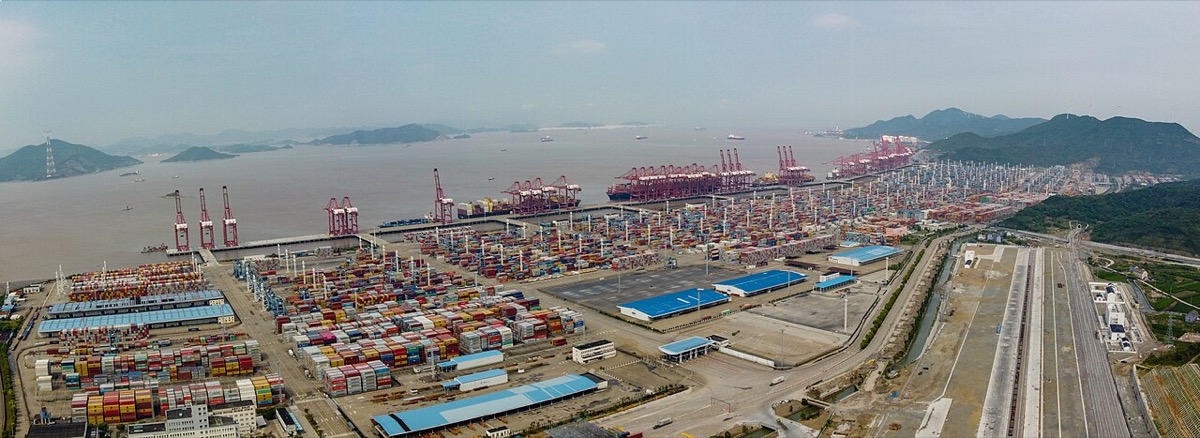
MFN base: 6.5% = $4,420. Section 301 List 3: 25% = $17,000. Fentanyl IEEPA: 20% = $13,600. Reciprocal: 10% = $6,800. MPF capped: $634. HMF: $85. Total duty + fees = $42,539. Effective rate = 62.6%. LDPE out of South Korea on HS 3901.10 would face a 15% reciprocal + 6.5% MFN = 21.5% effective, which is why half the LDPE volume that used to move Ningbo to Houston is now quoting through Yeosu.
What to Do With the Answer
Once your SKU-level effective rate is calculated, three actions follow naturally.
Rebuild your price list. If you sell to US converters or formulators, your cost-plus pricing is now materially different by SKU. A 34% effective stack line and a 62% effective stack line cannot share the same margin formula. Segment your catalogue by effective stack tier and reprice within each tier.
Refresh your alternate-origin quotes. Any SKU sitting above a 50% effective stack needs a live quote from at least two non-China origins. Korea and Taiwan for speciality chemistry. India for commodity intermediates. Vietnam and Thailand for downstream converted product. Keep the quotes in a rolling spreadsheet dated within the last 60 days, anything older is stale given how reciprocal rates have been moving by country.
Model the snapback. Run the same SKU list at a 34% reciprocal rate assumption (the pre-truce level the reciprocal would default to if November talks collapse). If that model takes more than 20% of your volume below breakeven, you have a hard deadline to diversify origin before 10 November.
The Classification Question Most Brokers Miss
Here is the move that has paid for itself three or four times over with clients this quarter. Look at every SKU currently classified under a “residual other” subheading (.90, .99, or .80 in many cases). Check whether a named subheading exists in the same HS heading with a lower MFN base. Then check whether that named subheading is on a Section 301 list.
Example from a client last month. An amine hardener for epoxy systems was entered under HS 3824.99.93.97 (other chemical preparations, other) at 5.0% MFN plus Section 301 List 4A (7.5% remaining in force) plus the full fentanyl + reciprocal stack. Correct classification under HS 2921.29 (acyclic polyamines) came in at 6.5% MFN but not on any Section 301 list. Net effect: dropped 18.5 points off the effective stack, saved $31,200 on a single 40HC, and the client is now refiling post-entry amendments on 11 months of prior shipments under 19 CFR 1520(d).
One More Thing on Fees
The MPF cap of $634.62 per entry is a planning lever people miss. If you split a 40HC shipment into two separate entries (for example, to consign to two different ultimate consignees), you pay MPF twice. Conversely, consolidating multiple small LCL shipments onto a single master entry through a licensed broker can keep you under the cap. On a year of 200 entries, that is $60,000 to $120,000 in fee arbitrage that rarely makes it into procurement’s line of sight.
The Next Action
Pull your top 30 SKUs by annual spend. Build the six-layer stack for each one. Flag anything above 55% effective. That is your Q4 diversification shortlist. The November truce deadline is 13 weeks out, which is exactly one supplier qualification cycle on speciality chemistry.
Sourzi runs a five-day landed-cost audit that produces the SKU-level stack, the reclassification opportunities, and the non-China alternate shortlist in one deliverable. Email ops@sourzi.com with your top 30 HTSUS lines and we will return a first-pass stack model within 48 hours.