GACC dropped the February 2020 trade data last week and it is about as bad as you would expect. China’s exports fell 17.2% year-on-year in US dollar terms. That is the worst monthly export decline China has recorded since the 2008 global financial crisis, and if you have been waiting on a chemical shipment and your freight forwarder keeps giving you vague answers, this data is telling you exactly why. Do not file it away as a macro statistic. The 17.2% figure is a direct measure of the supply chain disruption that has already hit your procurement timelines.
What 17.2% Actually Means, and Why This Is Not a Currency Story
When you see a double-digit export decline the instinct is to look for exchange rate effects. That is not what happened here. The yuan was relatively stable in February, so this is overwhelmingly a volume story. Chinese factories either could not produce, could not get cargo to port, could not get it loaded, or some combination of all three.
The trade surplus collapsed to $7.1 billion for the month, compared with $42.7 billion in January 2020 and $39.1 billion in February 2019. That is not a rounding error. Imports fell 4.0% year-on-year as well, which tells you domestic demand was suppressed at the same time. Factories that managed to reopen were not buying raw materials at normal rates, either because they had no confidence in near-term orders or because their own inbound logistics were broken.
During the 2008-2009 global financial crisis, China’s monthly export declines bottomed out around 25% year-on-year in early 2009. But that downturn was demand-driven from outside, meaning Chinese factories could at least sit ready to ship. This time the disruption is internal, supply-driven, and simultaneous across production and logistics. When demand collapses, you clear the backlog once buyers return. When production and logistics freeze simultaneously, the backlog compounds every single week the disruption continues.
Port Congestion: Why a “Reopened” Factory Does Not Mean Cargo Out the Door
This is the part that most supplier updates are not telling you, and it is the most operationally important thing in this entire post.
Zhejiang and Jiangsu are the two provinces with the highest concentration of chemical intermediate production for export. Ningbo-Zhoushan, the world’s largest port by cargo tonnage and the primary exit point for Zhejiang chemical exports, kept operating throughout February, but throughput dropped sharply. The workforce shortfall was the binding constraint, not a government order closing port operations. Crane operators, terminal handlers, and customs clerks were caught in the same return-to-work delays as factory workers.
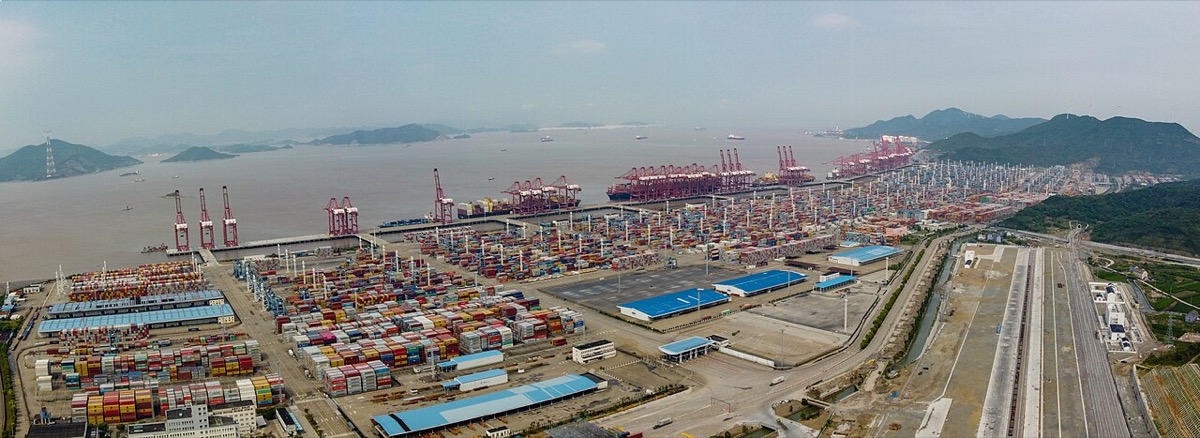
Shanghai Yangshan maintained operations with a reduced workforce, leaning on automation in sections of the deep-water terminal to partially compensate. The main problem at Yangshan was container equipment positioning. Empty containers had not been repositioned correctly after the pre-Chinese New Year export surge, creating an equipment imbalance that freight forwarders were scrambling to work around.
The result is that even factories that got their government restart permits in mid-February and had workers back on the floor by February 17 were running into 21 to 35-day lead times from booking to vessel departure. Pre-COVID normal was 7 to 10 days.
| Lead Time Component | Pre-COVID Normal | February 2020 | Difference |
|---|---|---|---|
| Factory production to gate ready | 5 to 7 days | 10 to 21 days | +5 to +14 days |
| Booking to container gate-in cutoff | 2 to 3 days | 7 to 14 days | +5 to +11 days |
| Gate-in to vessel departure | 3 to 5 days | 7 to 14 days | +4 to +9 days |
| Total booking-to-departure | 7 to 10 days | 21 to 35 days | +14 to +25 days |
Think about what that means. Your supplier sends a message saying the factory is back open and production is underway. You relax. But the bottleneck has simply moved downstream from the factory to the port, and that part does not show up in any supplier update.
Bulk liquid chemical shipments faced additional pressure on top of this. Specialised tanker vessels and ISO tank containers were already tight heading into Chinese New Year. The repositioning problem hit specialised equipment harder than standard dry containers, and there was no quick fix.
How to Use the GACC Data to Challenge Your Supplier’s Timeline
Your supplier’s current delivery estimate might reflect factory-side optimism with no accounting for port congestion reality. The GACC data gives you an independent benchmark for pressure-testing whether a shipping timeline is realistic right now.
If your supplier is quoting a vessel departure 10 to 14 days from production completion, that estimate requires port operations running at or near normal capacity. They are not. Port productivity at Ningbo-Zhoushan and Shanghai was running at 60 to 70% of normal levels through at least mid-February, and recovery is gradual.
Ask your supplier for two specific things: the vessel booking confirmation number and the freight forwarder’s estimate for container gate-in cutoff at the port. Those two data points tell you whether their timeline is a factory estimate or an actual booked sailing. If they cannot give you a booking reference, that departure date is aspirational, not confirmed.
Then cross-reference against the shipping line’s vessel schedule directly. If the vessel they claim to be targeting has already departed or has no available slots on the advertised date, you know the timeline needs revision before you build it into your production planning.
What to Ask Your Freight Forwarder Right Now
Your freight forwarder is your best real-time source on port conditions, but you need to ask the right questions specifically.
What is the current booking-to-departure lead time for standard FCL shipments from Ningbo or Shanghai for your chemical commodity class? Get a number, not a general answer.
Are there equipment availability issues for the container type your cargo needs? ISO tanks, flexibags, and specialised hazmat containers are all in shorter supply than standard dry containers right now.
Are there carrier blank sailings on your typical trade lane for the next three to four weeks? Several major carriers announced blank sailings in late January and February in response to reduced cargo volumes, and those reductions affect available space even as cargo starts to recover.
What is the current transit time variance from departure to arrival at your US port of entry? Higher-than-normal variance needs to go into your planning buffer.
Updating Your Q2 Planning Models for Extended Lead Times
Standard landed cost models assume predictable lead times because holding costs and carrying charges are a function of how long capital is tied up in transit. When lead times extend from 28 days to 50 days, carrying costs increase substantially. On a $300,000 chemical shipment at a modest 1.5% annual carrying cost, you are running about $12 per day in capital cost. An extra 22 days in transit adds $264 in carrying cost on that shipment alone, before any demurrage or detention charges at the US port of entry.
Build a lead time range into your model for the next two quarters. A conservative case of 45 to 55 days port-to-port including booking lead time. A base case of 35 to 45 days. An optimistic case of 25 to 35 days. Run your unit economics against all three scenarios. If the conservative case makes a shipment unprofitable at your current contract price, have that conversation with your supplier or your end customer before cargo is booked.
The February GACC data is a lagging indicator of what your supply chain has already absorbed. Its real value for procurement teams right now is as a benchmark for pressure-testing supplier delivery estimates and freight forwarder timelines. A 17.2% export collapse does not resolve in a single month. Your planning horizon through Q2 2020 should reflect that reality rather than assume a return to conditions that may not materialise until Q3.
Plan for disruption. Verify every timeline independently by asking for booking references, not just factory production dates. Keep your freight forwarder on a weekly call until you have confirmed vessel departures in hand for your critical raw material lines.