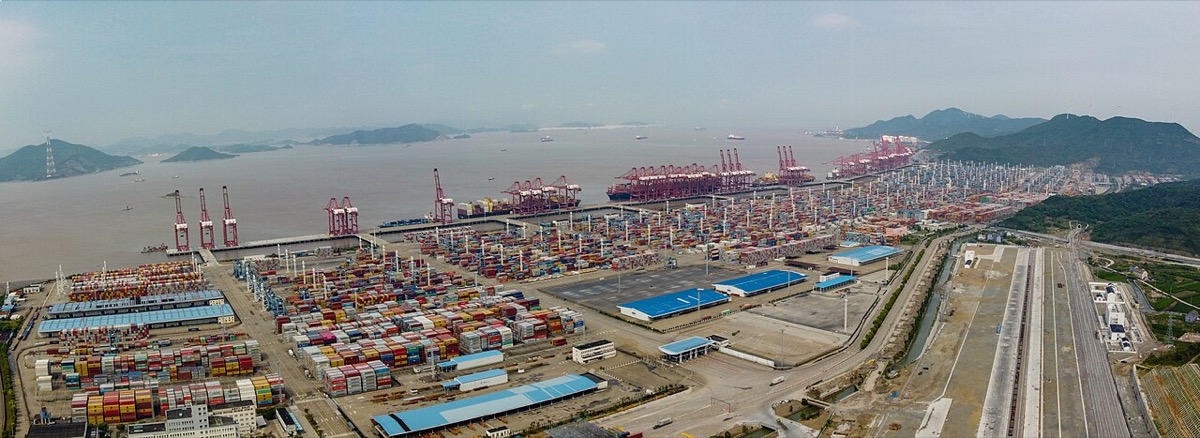
If you import anything with carbon in the name out of China, you spent Thursday morning reading MOFCOM Announcement No. 33 with the same sinking feeling the gallium and germanium buyers had back in July. On September 21, China’s Ministry of Commerce and the General Administration of Customs jointly published export control measures covering natural flake graphite, spherical graphite, expandable graphite, and several categories of high-purity synthetic graphite. The measures take effect December 1, 2023. From that date, every shipment out of Shanghai Yangshan, Ningbo-Zhoushan, Qingdao, or any other Chinese port will need an export licence issued by MOFCOM before the container is allowed onto the vessel.
The scope is broad and the timing is pointed. China produces roughly 65% of the world’s natural graphite and close to 90% of the world’s synthetic graphite, which in practical terms means the anode of nearly every lithium-ion battery on the planet starts its life in a Heilongjiang flake mine or a Shandong calciner. The new controls cover HS 2504.10 and 2504.90 for natural graphite, HS 3801.10 for artificial graphite, and the purity-coded subheadings that Chinese customs uses internally for spherical graphite above 99.9%. If you’re buying any of that, you’ve got roughly ten weeks to land volume under the old regime, get your long-term contracts restructured around licence availability, and talk to your freight forwarder about what “licence exception” documentation even looks like at Yangshan.
This isn’t a tariff. It’s a licensing chokepoint. MOFCOM hasn’t said how long licence processing will take, how many will be approved, or which end-uses will be prioritised. If the gallium and germanium precedent from August and September is any guide, the answer is “slowly, opaquely, and with a strong bias toward buyers who can demonstrate non-military end-use.” Battery and steel customers will probably get through. Boutique graphene R&D buyers will probably not.

What Announcement No. 33 Actually Covers and What It Leaves Alone
The announcement splits graphite into two regulated baskets and one that is partially loosened. The first basket is high-purity, high-strength, high-density synthetic graphite. That means material with density above 1.73 g/cm3, particle size below certain thresholds, and flexural strength above 30 MPa. Anode-grade artificial graphite for EV batteries sits squarely inside this bucket. So does isostatic graphite used in EDM electrodes and specialty furnace components.
The second basket is natural flake graphite and its downstream products: coated spherical graphite, expanded graphite, and expandable graphite. Coated spherical graphite is the precursor for natural-graphite anodes, and the coatings used by BTR, Shanshan, and Putailai are the main value-added step between a Chinese mine and a Korean or Japanese cell maker. All of that flow is now licence-gated.
What was loosened is worth noting. The old 1997-vintage dual-use controls on less-than-99.9% purity flake graphite have been removed, which means the bulk refractory grades used in steelmaking and foundry work will move on a simpler general licence regime rather than the former dual-use procedure. In practice, refractory buyers will see marginal relief while anode buyers see an entirely new regulatory layer.
Sinopec’s Shanghai petrochemical arm, BTR in Shenzhen, Shanshan in Ningbo, and Putailai in Liyang will all need export licences for every shipment from December 1 onward. MOFCOM has said it will process applications in 45 working days, which sounds tolerable until you realise that 45 working days from a December 15 filing puts your approval into mid-February 2024. If you’re running a battery plant in Kentucky or a cathode coater in South Carolina that burns 400 tonnes of anode-grade material a month, you cannot afford a February approval window.
What This Means for Your Landed Cost Through the End of 2023
Spot prices for coated spherical graphite were already moving before the announcement. Fastmarkets had anode-grade spherical graphite at USD 3,100 per MT CIF Korea in early September, up from USD 2,850 in June. The immediate post-announcement reaction pushed quotes from Heilongjiang refiners toward USD 3,400 by the week ending September 22, with lead times pushed from four weeks to six.
Here is the landed cost arithmetic for a representative 20-foot container of coated spherical graphite moving from Qingdao to Long Beach under contracts signed before and after the announcement.
| Line item | Pre-announcement, signed early Sept 2023 | Post-announcement, spot quote Sept 22 2023 |
|---|---|---|
| FOB Qingdao, USD/MT | 2,950 | 3,400 |
| Ocean freight, USD per 20 ft (20 MT) | 1,420 | 1,420 |
| Freight per MT | 71 | 71 |
| Marine insurance, 0.12% of CIF | 3.65 | 4.17 |
| US customs duty (HS 3801.10.5000, MFN free) | 0 | 0 |
| Section 301 List 3, 25% ad valorem | 755.91 | 868.80 |
| Harbor maintenance fee, 0.125% of entered value | 3.78 | 4.34 |
| Merchandise processing fee, 0.3464% capped at 614.35 | 10.48 | 12.04 |
| Drayage Long Beach to SoCal DC, USD per container | 950 | 950 |
| Drayage per MT | 47.50 | 47.50 |
| Landed cost, USD/MT | 3,842 | 4,408 |
A 15% landed cost increase before the licence regime has even started is what the market is already pricing in. That does not include the risk premium for a shipment that gets hung up at Qingdao waiting on MOFCOM paperwork. If you ship in December under a licence that gets delayed, you’re paying demurrage on the Chinese side, storage at the port of loading, and, on the US side, you’re running your battery plant on safety stock you probably don’t have.
The Precedent You Should Be Studying: Gallium and Germanium
MOFCOM’s August 1, 2023 gallium and germanium licence regime is the closest historical analogue, and the early data is instructive. In July 2023, the month before controls took effect, China exported 5.15 tonnes of gallium metal and 8.63 tonnes of germanium products. In August, the first month under the new regime, exports fell to zero. Not “low.” Zero. September data released by GACC this week shows 1 tonne of gallium shipped, still roughly 80% below the trailing six-month average.
The licences are being issued. They’re just being issued slowly and selectively. Reuters reported last week that the first batch of gallium export approvals went to a small handful of integrated customers with demonstrable semiconductor or LED end-use, with paperwork that took around 60 days to clear MOFCOM rather than the stated 45-working-day target.
If graphite follows the same pattern, expect December and January Chinese graphite export volumes to be materially lower than recent monthly averages, and expect the licences that do issue to favour large, integrated battery customers with paper trails that prove automotive end-use. Smaller buyers, trading houses, and anyone supplying defence or space applications should plan for significantly longer processing times.
What US and Australian Battery Anode Buyers Should Be Doing This Week
You’ve got roughly sixty working days before December 1 and another forty-five working days of licence processing risk after that. Here is the action list we’re walking clients through this week.
Expedite every open PO. If you have a confirmed order that can physically ship before November 30, get it on the water. Chinese exporters and forwarders will prioritise pre-December bookings because they can be cleared under the existing regime without the new licence. Expect FOB prices to firm further over October as everyone tries to pull volume forward, but the incremental cost of an extra 5% on FOB is small next to the cost of a stranded licence application in January.
Get a second source qualified. Syrah Resources in Louisiana operates the Vidalia anode facility using Mozambique flake graphite from its Balama mine. Posco Chemical is expanding anode capacity in Sejong. Novonix in Tennessee is ramping synthetic graphite. None of these are drop-in replacements for a Chinese-sourced BOM on day one, but qualification programmes take 12 to 18 months and you should be starting them today, not in March. Section 45X of the Inflation Reduction Act offers a USD 45 per kWh production tax credit on battery cells and modules assembled with qualifying anode, so the non-China sourcing math is improving.
Restructure your Chinese contracts. Move from volume-committed annual pricing to quarterly nominations with an explicit export-control carve-out. Your Chinese supplier’s legal team will push back, but every Chinese manufacturer’s in-house lawyer has spent September re-drafting these clauses and there is a market-standard form in circulation. The carve-out needs to say that inability to obtain a MOFCOM export licence is a specific excused event, not general force majeure, and it needs to put the burden of licence application on the exporter with a defined cure period.
Document your end-use. MOFCOM’s application form requires detailed end-use disclosures, end-user certificates, and often a statement from the ultimate importer. If you’re the importer, get your customer, or your own production department, to issue an end-use statement naming the facility, the end product, and the commercial application. A vague “industrial use” answer on the application form will get your licence kicked back for clarification and another 20 working days will disappear.

How Australian Importers Fit Into This
If you’re an Australian importer sitting in Melbourne or Brisbane reading this and wondering whether it applies to you, the answer depends on your customer base. Australia does not operate large-scale EV battery cell production, so direct anode imports to Australia are modest. However, quite a lot of Australian-registered trading houses move graphite between China and Korea, China and Japan, and China and the US on back-to-back contracts. If your company is named as the exporter of record on the MOFCOM licence application or as the consignee at Qingdao, you are inside the regulated perimeter regardless of where the material ultimately lands.
The Department of Foreign Affairs and Trade has not issued Australian-side guidance on the new controls yet, but ASIC-registered trading entities doing back-to-back graphite deals should expect their Chinese shipping documents to reference the MOFCOM licence number from December 1 onward. If your documents don’t reference a licence, your freight forwarder in China will not be able to complete export clearance.
The upstream opportunity is real. Australia has the Balama project pipeline through Syrah, Renascor Resources’ Siviour project in South Australia targeting 150,000 tonnes per annum of natural flake graphite, and Magnis Energy Technologies’ downstream anode work. Every non-China qualification programme that gets accelerated this quarter will look at Australian flake as a natural fit with Japanese and Korean anode coaters who are under their own national-security pressure to diversify away from Chinese supply.
The 90-Day Playbook, in Dates
Before October 15: audit every open PO with a Chinese graphite supplier and classify it into three buckets: ships before November 30, ships December or later but licence-critical, or can be cancelled and re-sourced.
Before October 31: send your top three Chinese suppliers a formal request for their licence application timeline and the specific end-use documentation they need from you.
Before November 15: file end-use statements with each supplier, confirm freight bookings for any volume targeting a pre-December 1 load, and audit your sales contracts with downstream customers for force majeure language that might or might not pass through an export-control event.
Before November 30: make sure all pre-regime volume is loaded and bill-of-lading dated on or before November 30. A B/L dated December 1 or later will need a MOFCOM licence no matter when the goods actually left the factory.
Before December 31: begin formal qualification programmes with at least one non-China source. Balama-Vidalia, Siviour, and Korean-origin synthetic are the first places to look.
If you’ve got a specific PO you’re worried about, send your PO number, load port, and HS classification through our contact form and we’ll walk it through the licence decision tree on a call this week. December 1 is 67 days away, and MOFCOM is not going to wait for anyone.