Three numbers landed on importers’ desks in the back half of December 2025, and together they rewrite the chemical sourcing model you’ve been running since the Houthis first started firing at ships in late 2023. The Drewry World Container Index printed $2,213 per forty-foot unit for the Shanghai to Los Angeles lane on 18 December, a fall of around 55 to 62% from the 2024 peaks depending on the week you reference. The French carrier CMA CGM sent its 17,859-TEU Benjamin Franklin through the Suez Canal on 15 December, the first mega-ship transit since the Red Sea crisis began. And the General Administration of Customs of China confirmed the November trade print, which pushed the January-to-November cumulative surplus across the US$1.08 trillion line, a record, up 22.1% year-on-year.
Each of those data points is interesting on its own. Together they change the arithmetic on every container and every ISO tank you’ve booked into Q1 2026, and they reset the conversation you need to have with your carrier account manager before Chinese New Year closes the window on 17 February.
The freight number: a Drewry WCI print that looks nothing like 2024
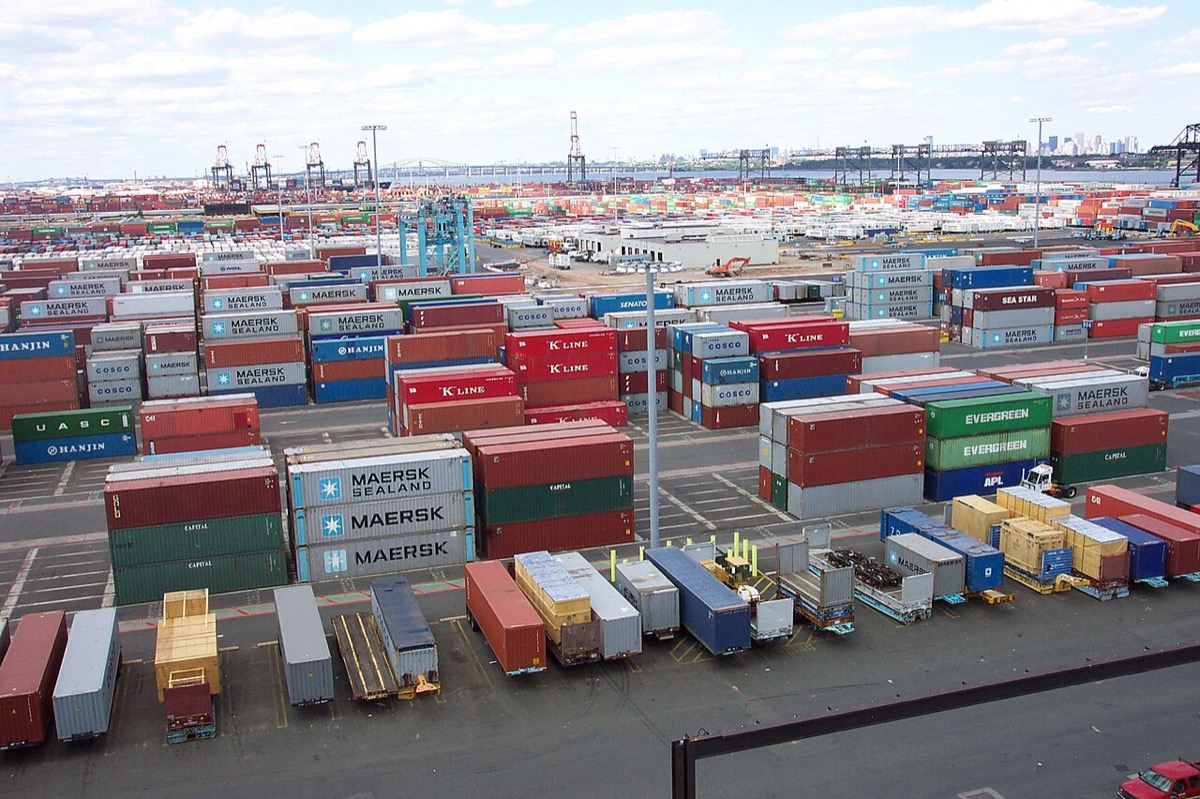
Start with the rate sheet. The Drewry composite WCI closed December at around $2,046 per FEU, and the Shanghai-to-LA lane specifically read $2,213 on the 18 December print. Shanghai to New York via the all-water route came in around $3,147, still elevated versus the trans-Pacific but down from the $6,000-plus prints the same lane was seeing in mid-2024 when Red Sea reroutings had soaked up every available box.
To put that in perspective, the long-run average for Shanghai-LA between 2017 and 2019, before COVID distortion, was roughly $1,420. So we’re still running about 56% above the pre-pandemic floor, but we’ve given back an enormous amount of the rerouting premium that defined the last eighteen months.
| Period | Shanghai to LA ($/FEU) | Shanghai to NY ($/FEU) | Drewry Composite |
|---|---|---|---|
| Pre-COVID 2019 average | 1,420 | 2,640 | 1,420 |
| July 2024 peak | 6,855 | 9,612 | 5,901 |
| September 2025 | 2,486 | 3,890 | 2,412 |
| October 2025 | 2,291 | 3,547 | 2,180 |
| November 2025 | 2,198 | 3,220 | 2,096 |
| 18 December 2025 | 2,213 | 3,147 | 2,046 |
The Shanghai Containerized Freight Index tells a similar story. SCFI closed 12 December at 1,284 points, versus a 2024 peak near 3,700. The Xeneta short-term Asia-North America index printed $2,180 per FEU on the same week.
What collapsed the number? Three things stacked on top of each other. Carriers added 2.3 million TEU of new-build capacity across 2024 and 2025, a historic delivery cliff timed badly. Demand normalised after the US importers pulled holiday orders forward through Q3 and front-loaded for the tariff calendar. And the Red Sea started reopening to transits in November, which released the rerouted tonne-miles that had absorbed the surplus boxes for most of 2024.
If you’re writing a 2026 service contract on MQC tonnage, this is the rate environment you negotiate into. The carriers know it too. Maersk’s Gemini joint service with Hapag-Lloyd is quietly accepting 12-month tenders at numbers that would have been laughable in June. MSC is holding firmer on spot but has given ground on annual volume commitments.
The ship: CMA CGM Benjamin Franklin and the Suez recovery arithmetic
The second data point is the one that caused the rate move. On 15 December 2025, the Benjamin Franklin, a 17,859-TEU Explorer-class CMA CGM mega-ship, transited southbound through the Suez Canal from Port Said to the Bab el-Mandeb and continued to Jeddah and onward. It was the first vessel of that scale to complete the transit since December 2023, when the Galaxy Leader hijacking triggered the mass diversion around the Cape of Good Hope.
CMA CGM’s position has been clear since October: they had been running selected ships through the canal for months on the group’s own risk assessment, and with the US-brokered November ceasefire holding through the Gaza file, the French carrier chose to send a flagship vessel and announce it publicly. Maersk remained on the Cape routing through mid-December. MSC, Hapag-Lloyd, and ONE were watching.
The arithmetic on the transit is worth walking through, because this is where your bunker and insurance costs actually live.
| Metric | Cape of Good Hope | Suez Canal | Delta |
|---|---|---|---|
| Shanghai to Rotterdam transit (days) | 40 to 45 | 28 to 32 | 12 days saved |
| Nautical miles | 14,180 | 10,870 | 3,310 saved |
| Fuel burn per FEU (MT) | 0.62 | 0.48 | 0.14 MT saved |
| IFO380 bunker cost saved per FEU | $84 | - | $84 |
| War-risk premium per voyage | $0 | $280K to $420K | Added back |
| Suez transit toll (14,000-TEU ship) | $0 | $780K to $950K | Added back |
On a per-container basis, the Cape routing actually carried a smaller insurance and toll line for most carriers, but it burned 12 more days of working capital on every box, ate an extra 14% of annual fleet TEU-miles, and forced carriers to contract charter capacity at premium rates to hold weekly service frequency. The Suez return means those chartered-in vessels get released back to the market, which is exactly the supply shock that pulled the Drewry number below $2,300.

The scepticism is fair. Red Sea container throughput at Suez was still down roughly 75% from the pre-crisis baseline as of the 8 December weekly canal authority bulletin, and war-risk insurance rates haven’t normalised. But the trajectory is unmistakable: the Houthi Magic Seas sinking on 6 July 2025 and the subsequent ceasefire wobble produced a spike that faded within weeks, and the November US-brokered framework has held longer than sceptics expected. CMA CGM made a bet. If Maersk matches, the Drewry number drops another $400 by February.
The third number: $1.08 trillion and what GACC is actually telling you
The November GACC release confirmed that cumulative Jan-Nov 2025 exports reached US$3.46 trillion, up 7.6% year-on-year, while imports came in at US$2.38 trillion, up 1.3%. The resulting surplus of US$1.08 trillion is a Chinese record and a global record for any single economy measured over 11 months.
The headline is loud, but the composition is what matters for a chemical importer. Exports to the US fell 8.3% year-to-date in dollar terms, while exports to ASEAN rose 14.7%, to the EU rose 6.2%, to Latin America rose 13.9%, and to Africa rose 11.8%. China has been rerouting product through the RCEP ecosystem and into Belt and Road trade partners at a pace that says more about its production surplus than about any single policy lever.
| Destination region | Jan-Nov 2024 ($B) | Jan-Nov 2025 ($B) | YoY change |
|---|---|---|---|
| United States | 471 | 432 | -8.3% |
| ASEAN (10 members) | 510 | 585 | +14.7% |
| European Union | 466 | 495 | +6.2% |
| Latin America | 202 | 230 | +13.9% |
| Africa | 156 | 174 | +11.8% |
| Middle East | 174 | 186 | +6.9% |
For the chemical segment specifically, HS Chapter 29 organic chemicals exports from China printed US$68.2 billion across Jan-Nov, up 4.1% YoY. HS Chapter 28 inorganics ran US$41.9 billion, up 3.2%. HS Chapter 39 plastics exports hit US$128 billion, up 9.1%. The US share of Chinese chemical exports contracted from 11.4% in 2023 to 9.2% in 2025. Vietnam, India, and Mexico absorbed most of the diverted tonnage.
What that tells you as a US importer is that your supplier still has plenty of demand without you. The negotiating leverage you had in late 2022 when Chinese factories were desperate for orders has flipped. Wanhua, Sinopec subsidiaries, and the mid-sized Shandong and Jiangsu producers are pricing in the alternative buyer who’ll take their tonnage CIF Jebel Ali or CIF Ho Chi Minh without asking about TSCA or IMDG 42-24. Your purchase order needs to be more attractive, not less, in 2026.
The landed cost stack: how the three numbers compound
Pull the three data points into a single container. Take a 20-foot ISO tank of a mid-tier specialty, UN 1760, packing group II corrosive liquid, shipped from Shanghai Yangshan to Los Angeles under IMDG 42-24.
| Landed cost line | December 2024 ($/TEU) | December 2025 ($/TEU) | Change |
|---|---|---|---|
| FOB Shanghai price | 14,200 | 14,600 | +$400 |
| Ocean freight, Shanghai to LA | 5,820 | 2,213 | -$3,607 |
| IMDG 42-24 DG surcharge | 320 | 480 | +$160 |
| Bunker adjustment (BAF) | 540 | 410 | -$130 |
| Low-sulphur surcharge (LSS) | 210 | 180 | -$30 |
| War-risk / Red Sea surcharge | 420 | 140 | -$280 |
| Terminal handling, LA | 380 | 395 | +$15 |
| Section 301 + reciprocal tariff (illustrative 32%) | 4,544 | 4,672 | +$128 |
| Customs broker, ISF, bond, CBP fees | 295 | 305 | +$10 |
| Drayage, LA to inland DC | 780 | 795 | +$15 |
| Total landed cost | 27,509 | 24,190 | -$3,319 |
The ocean freight collapse alone moves the all-in landed number by roughly 12%. Every other line is a rounding error against that one. If you’ve been budgeting 2026 against 2024 freight assumptions, you’ve built a 10 to 12% price buffer that no longer exists, and your commercial team will quietly absorb it as margin unless you formalise the pass-through terms in your customer contracts.
What IMDG 42-24 changes about the calculation
The IMDG Code amendment 42-24 entered into force on 1 January 2025 with a 12-month transition window and hardens into mandatory status on 1 January 2026. The amendment tightens documentation and segregation for a range of UN numbers and introduces stricter requirements for lithium battery-related entries and certain corrosives. For chemical importers moving Class 3 flammables, Class 6 toxics, and Class 8 corrosives, the practical consequences are higher DG surcharges and more carrier rejections of incomplete paperwork. The DG surcharge increase from roughly $320 to $480 per TEU looks small against the freight collapse, but it’s sticky. Carriers don’t discount DG surcharges in a soft market.
The contract window: why mid-December is the negotiation moment
Trans-Pacific service contracts typically renew on an 1 April or 1 May effective date. The tender cycle runs through January and February, with beauty parades in late January and signed MQC volumes by early March. That means the conversation you start now, in the week of the Drewry $2,213 print, is the one that locks your rate for 12 months.
Three tactical points matter. First, ask for a named-account rate rather than a NAC tariff. Carriers in a soft market will give you a floor below the NAC filing, and the differential can be $200 to $400 per FEU. Tier-1 shippers with 2,500-plus FEU annual volume are getting Shanghai-LA quotes in the $1,900 to $2,050 range for April 2026 effective dates.
Second, tie your volume commitment to a bunker floor mechanism rather than a fixed all-in. IFO380 bunker at Singapore printed $486 per MT on 12 December versus $545 a year ago. If oil rallies, you want the contract to move with published BAF indices rather than reopen the base rate. Third, on DG lanes, negotiate the UN-number list explicitly. For a shipper moving UN 1760 corrosive liquids NOS and UN 1993 flammable liquids NOS, the per-UN-number carrier will typically be $80 to $140 cheaper than the flat per-TEU carrier on a mixed container.
The risk you still carry
The Red Sea is not fixed. Container vessel traffic at Suez remains around 25% of 2023 baseline, and war-risk insurance for transit still runs 0.7 to 1.0% of vessel value. The Panama Canal has its own drought risk into FY2026 slot allocation. China’s US$1.08 trillion surplus is politically destabilising, inviting tariff action in both Washington and Brussels. If the Busan framework wobbles in Q1 2026, the April controls still technically active on rare earths and a subset of HS Chapter 29 entries could tighten further. Freight rates can snap back. The 55 to 62% fall from the 2024 peak reflects capacity oversupply, a functional Suez, and a normal seasonal soft patch. Any one of those can reverse in 30 days.
The playbook into Q1 2026
Tighten your volume commitments now. Lock 40 to 60% of your 2026 trans-Pacific tonnage at the December 2025 spot environment plus 8 to 12% for contract premium. Leave the remainder on spot so you can benchmark if rates fall further into March, which is the base case if capacity deliveries continue at the current pace.
Review your supplier contracts for CIF versus FOB terms. If your supplier is quoting CIF LA at a price that assumed December 2024 freight, you’re leaving $3,000 to $3,500 per FEU on the table. Renegotiate to FOB Shanghai and control the carrier selection yourself.
Sort your IMDG 42-24 compliance before 1 January 2026. The transition window closes and carriers will reject shipments with 42-22 paperwork. Your forwarder should have already sent you the updated DG declarations; if not, you’re behind.
Run the landed cost model on your top ten SKUs using the December 2025 numbers. Share the revised FOB equivalent with your commercial team before the holiday break so 2026 price lists reflect the current stack rather than the 2024 one.
One more number to watch
The 2025 US fiscal year ended 30 September with China chemical imports down 18.4% in volume and 13.1% in value versus FY2024. December 2025 US Census Bureau data will be published on 6 February 2026 and that print will tell you whether the freight collapse has accelerated the Chinese share recovery or whether Vietnam, India, and Mexico continue to eat into the trade lane.
If Chinese volume stabilises and freight stays below $2,500 into Q2, 2026 is the first normal planning year since 2019. If freight rebounds above $3,500 or China volume keeps falling, the ASEAN reroute becomes the default sourcing strategy rather than the contingency. Either way, the three numbers from this December rewrote the model. The version you were running in October is already out of date.