Your WeChat messages haven’t been read in eight days. The phone rings and nobody answers. The last email you got from your supplier in Minhang said “everything is under control, production is normal,” but the signature line was from 22 March and you haven’t heard a word since. Meanwhile, the satellite imagery of Yangshan and Waigaoqiao shows more than 470 vessels queued across East China, and the Puxi lockdown that started on 1 April has now folded into a full-city stay-at-home order covering all 25 million residents.
If you’re holding purchase orders with a Shanghai-based chemical supplier right now, you’ve got a concrete problem that doesn’t fix itself. Either your supplier is genuinely operating under a closed-loop manufacturing arrangement, or they’re sitting on unfinished product with nobody in the plant, or they’ve stopped responding because they don’t want to tell you the truth. You need to know which one it is before you commit more funds, divert containers, or promise a downstream customer a delivery date you can’t meet.
This is the real-time verification guide. Who to call, what to ask for, how to spot a fabricated “we’re running fine” message, and how to get a pair of eyes inside a facility when your supplier’s sales team has gone dark.
Why “We’re Operating” Means Almost Nothing Right Now
Shanghai’s lockdown architecture is more complicated than a single shutdown order. The city’s been divided into three tiers: closed zones (feng kong qu), controlled zones (guan kong qu), and prevention zones (fang fan qu). Factories inside closed and controlled zones are generally not permitted to run standard operations. Factories inside prevention zones can run, but staff movements between home and plant are restricted, and anyone crossing a zone boundary can trigger a 14-day isolation.
The workaround for critical facilities is closed-loop manufacturing. Workers live on-site in dormitories, the plant perimeter becomes a sealed bubble, and raw materials come in through a single quarantined checkpoint. Tesla, SMIC, and a small number of automotive suppliers have been approved for closed-loop operation. A handful of chemical producers in Jinshan Chemical Industry Park and Pudong have also got permits, but the number is small and the list changes weekly.
So when your supplier messages “we’re operating normally,” they might be telling you they’re on the approved closed-loop list. More often, they mean a skeleton crew is somewhere in the facility and inventory is being moved out of an on-site warehouse, but no actual production is happening. Those two scenarios look identical in a reassuring WeChat message and land very differently on your P&L six weeks from now.
Ask the specific question. Not “are you operating.” Ask: “Are you approved for closed-loop manufacturing, what’s your permit number, when was production last active, and what’s your current finished goods inventory in MT?” If the answer comes back vague or changes across messages, you’ve got your answer without needing to call anyone.
The Ground-Truth Check: Which Zone Is Your Supplier Actually In
Before you spend any money on third-party verification, work out which lockdown zone your supplier’s plant sits in. The Shanghai municipal government publishes zone lists daily, and local WeChat channels update them faster. A supplier in Jinshan District or Chemical Industry Zone has a very different operational reality than one in Minhang or central Pudong.

The pattern that’s emerged over the last two weeks: most chemical distributors and trading companies registered in central Puxi or Pudong can’t touch their inventory. Their warehouses are inside closed zones. Even if they’ve got product, they can’t move it to the port. The producers in Jinshan Chemical Industry Park and parts of Fengxian have had some closed-loop continuation, but they’re running at 40 to 60% of normal output and their trucking capacity into Yangshan has collapsed because drivers can’t cross zone boundaries without 48-hour PCR windows.
| District | Primary Chemical Cluster | Operating Status (15 April) | Trucking Access to Yangshan |
|---|---|---|---|
| Jinshan | Shanghai Chemical Industry Park | Partial closed-loop, 40-60% capacity | Permitted with PCR + permit |
| Pudong | Waigaoqiao bonded zone, trading companies | Largely shut, inventory stuck | Severely restricted |
| Minhang | Specialty chemicals, distributors | Full lockdown, production halted | Not permitted |
| Songjiang | Intermediates, trading warehouses | Full lockdown, production halted | Not permitted |
| Fengxian | Fine chemicals, pharma intermediates | Partial operation, staff shortages | Restricted, long queues |
| Qingpu | Packaging, logistics hubs | Full lockdown, drayage stalled | Not permitted |
If your supplier’s registered address is in Minhang or Songjiang and they’re claiming normal production, that claim doesn’t match the zone reality. They might be trying to hold you on the PO rather than release you to a competitor.
The Third-Party Inspection Playbook When You Can’t Get There Yourself
SGS Shanghai, Bureau Veritas, Intertek, and TÜV SÜD all maintain Shanghai operations, and all of them have inspectors with the permits and PCR protocols to move across zone boundaries for industrial work. Not all of them can reach every facility right now, but they can reach more than you can on your own.
The trick is knowing what to ask for. A standard pre-shipment inspection doesn’t cover what you need here. You’re not trying to confirm product specification. You’re trying to confirm the supplier has a functioning plant, staff on site, and inventory that actually exists. That’s a factory audit, not a quality inspection, and it’s a different service line.
Call the SGS Shanghai office directly rather than routing through your US or European SGS contact. The Shanghai office knows which facilities are reachable this week and which have completely shut down to external visitors under local health regulations. Ask for an operational verification audit: photograph the plant gate and date-stamped security log, confirm production staff headcount on site, photograph finished goods warehouse and count pallets/drums/IBCs, verify production line is running or not running, and get copies of the last three days of production records if the supplier is claiming active output.

Bureau Veritas Shanghai has a slightly different operational footprint and, in our experience this month, has been able to access a couple of Jinshan facilities that SGS couldn’t get into due to site-specific permit rules. Don’t assume one agency has universal access. If the first agency can’t reach the plant this week, try the second one.
Local inspection agencies with movement permits can sometimes move faster than the international names, particularly for smaller facilities. CCIC (China Certification and Inspection Group) has municipal-level permits in some districts that the foreign agencies don’t have. The trade-off is that the reporting standard is less rigorous and the documentation may not hold up in a commercial dispute as well as an SGS or Bureau Veritas report. For operational verification you need within 72 hours, a CCIC report is better than no report.
How to Spot a Fabricated “We’re Running Fine” Update
After three weeks of lockdown, we’ve seen every flavour of evasion. The common patterns:
The recycled stock photo. A supplier sends a “plant in operation” image that, on closer inspection, is either a file photo from 2019, a shot taken at a different facility, or a generic industry image off Baidu. Ask for the raw file with EXIF data intact. Most fabricated “we’re operating” photos fail this test immediately because the metadata shows a date months or years before the lockdown.
The vague timestamp. Messages that say “today” or “this morning” but won’t commit to a specific date and GPS-tagged image. Ask for a photograph with that day’s local newspaper visible, or a screenshot of a live news broadcast on a phone screen near the production line. A genuine supplier running closed-loop manufacturing has no problem providing this. A supplier who’s actually sitting in an empty plant will suddenly find a reason to delay.
The delegate chain. “Our Shanghai team is handling it, I’ll get back to you.” Two days pass. “Our Shanghai team is still coordinating.” The sales contact you’re dealing with is probably in Beijing or Shenzhen and has no idea what’s happening on the ground, and the Shanghai team is unreachable or not responding. This isn’t necessarily dishonesty. It’s often the truth of the situation. But it’s also a signal that nobody actually has operational information, and you should assume production is not happening until proven otherwise.
The payment nudge. Any supplier who, during a week when they haven’t provided a single verified update, asks you to wire the next PO deposit or release the letter of credit, is not acting in your commercial interest. Pause all new financial commitments to Shanghai-zone suppliers until you’ve got third-party verification of operational status.
What Yangshan Port Backlog Does to Your Landed Cost
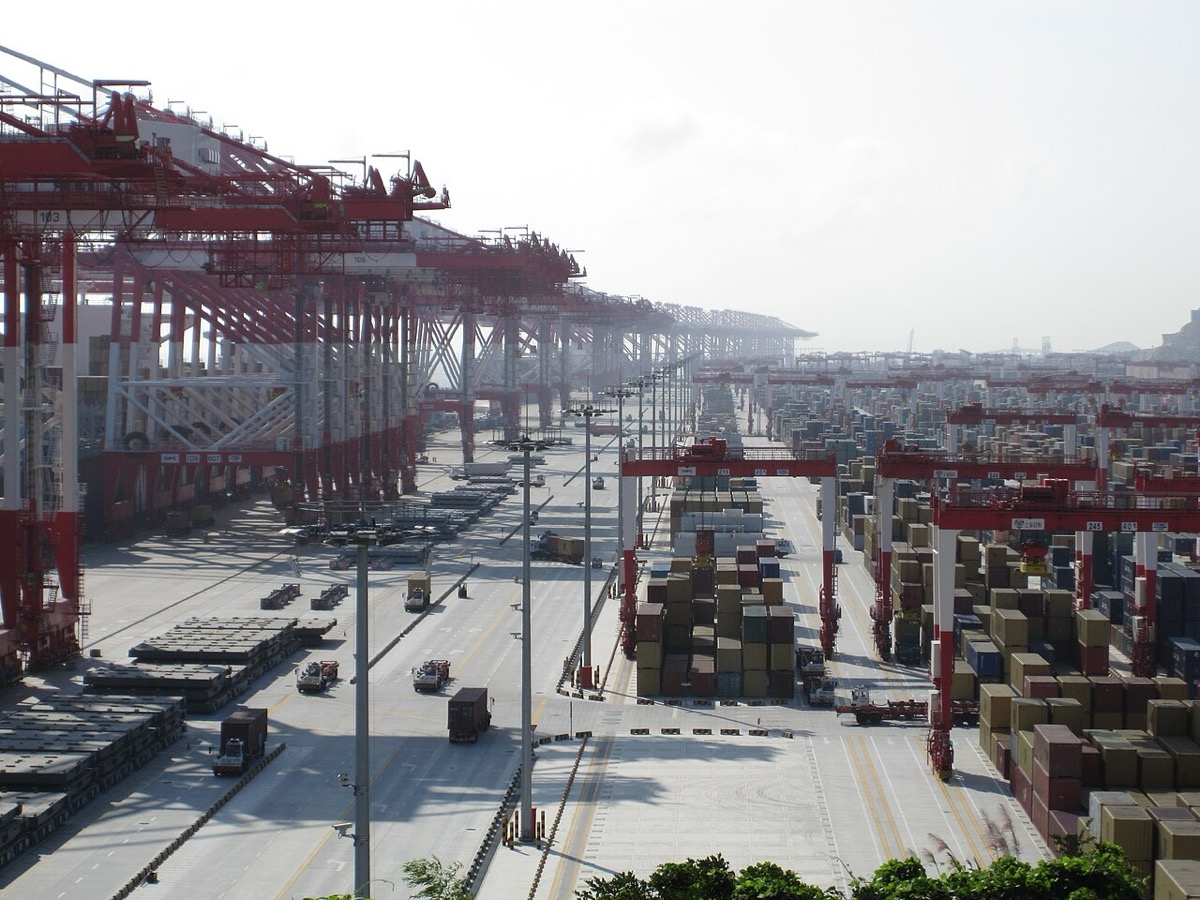
Even if your supplier is fully operating under closed-loop conditions, the port side of the equation is its own problem. More than 470 vessels are queued in East China waters as of early April, concentrated around Yangshan and Waigaoqiao. Average wait time for a container vessel to berth at Yangshan has stretched from a normal 24 to 48 hours out to 8 to 12 days. Carriers have started blanking sailings from Shanghai and shifting capacity to Ningbo-Zhoushan, which is operational but absorbing diverted volume and building its own congestion.
Here’s what that translates to for a 20-foot ISO tank of industrial chemical booked in early April:
| Cost Component | Normal Conditions | Current Conditions (April 2022) |
|---|---|---|
| FOB Shanghai ex-works price | $1,800/MT | $1,800/MT |
| Inland trucking to port (Shanghai) | $80/MT | $180 to $250/MT (driver shortage, PCR) |
| Port handling and terminal fees | $60/MT | $90 to $120/MT (congestion surcharges) |
| Ocean freight Shanghai-LA (FEU basis) | $7,000/FEU (~$350/MT on 20MT tank) | $9,500 to $11,000/FEU (~$475 to $550/MT) |
| Section 301 tariff (25% of customs value) | $450/MT | $450/MT |
| Additional demurrage/detention exposure | Minimal | $400 to $800/MT (carrier delays) |
| Total landed cost estimate | ~$2,740/MT | ~$3,370 to $3,970/MT |
That’s a 23 to 45% increase in landed cost on the same product, driven almost entirely by logistics friction on top of a plant that might be running at half speed. If your downstream pricing assumes April 2021 landed cost, you’re eating the difference unless you’ve got price escalation language in your customer contracts.
The 72-Hour Action List for Your Shanghai-Exposed POs
Within 72 hours, you need to do five specific things.
First, pull every open PO you have with a supplier in Shanghai, Kunshan, or the greater Yangtze Delta zone. Flag them by plant district. Anything in Minhang, Songjiang, Qingpu, Pudong central, or central Puxi is effectively frozen regardless of what your supplier is telling you.
Second, for each flagged PO, send a written request for operational verification: permit number for closed-loop operation (if claimed), current inventory in MT, last production date, and willingness to host a third-party inspection. Give them 48 hours to respond with documents. No documents, no further funds released.
Third, book SGS Shanghai or Bureau Veritas for operational audits on your three highest-exposure positions. Don’t wait for the supplier to offer this. Instruct them it’s happening and coordinate logistics directly with the inspection agency.
Fourth, identify alternative supply in Shandong, Jiangsu (Zhangjiagang, Taizhou), or Zhejiang (Ningbo) for your critical products. Those provinces aren’t locked down. Wanhua in Yantai, Sinopec’s Shandong operations, and the cluster around Ningbo-Zhoushan are running and have inventory. You won’t get contract pricing on a spot deal, but you’ll get product moving.
Fifth, talk to your forwarder about shifting bookings from Shanghai to Ningbo-Zhoushan where your product allows. Ningbo is congested but functional. Shanghai is neither.
The Shanghai lockdown will end. The question is whether it lasts another three weeks or another twelve, and whether your downstream customers will accept “my supplier went dark” as an explanation for a missed delivery. You’re better off assuming twelve and moving now.